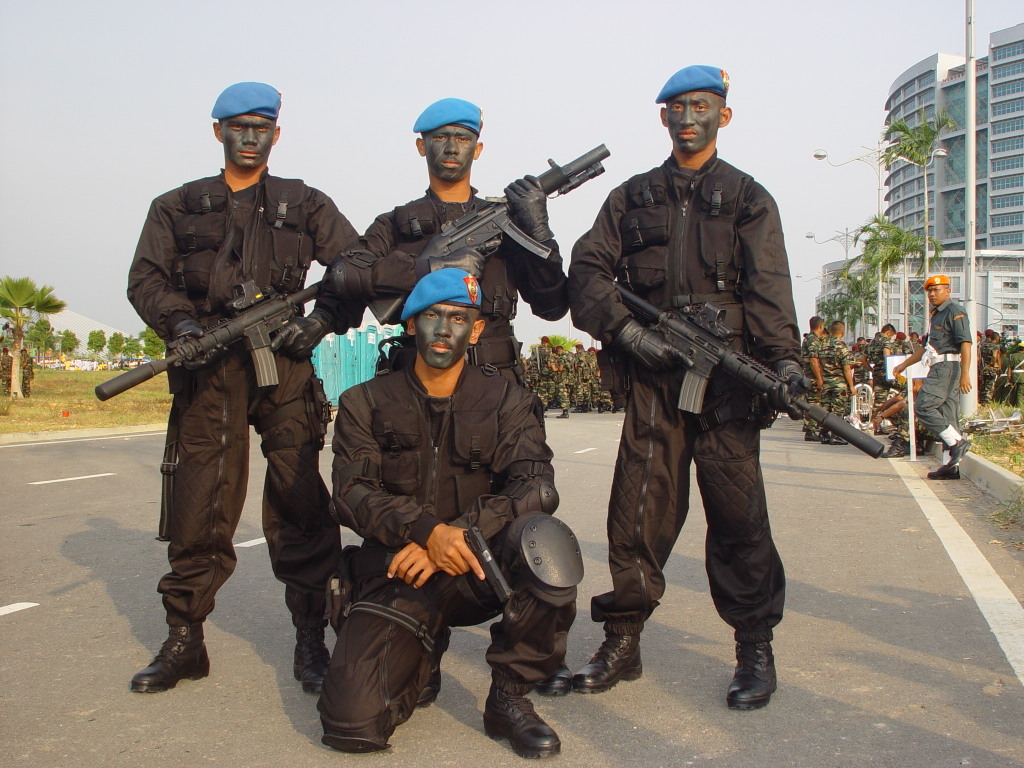
(Bernama) - Home Minister Datuk Seri Hishammuddin Hussein said the Royal Malaysian Police's Special Branch was working closely with the Philippine National Intelligence Coordinating Agency (Nica) to investigate and identify the mastermind behind the recent terrorist intrusion in Sabah.
"Our police Special Branch has good relations with the agency. We have obtained intelligence on the involvement of a third party and information on the (Jamalul) Kiram group.
"The intelligence could also involve the Moro Islamic Liberation Front (MILF), Nur Misuari group, politicians or terrorists," he told reporters after opening the Pusat Giat Semberong at the Taman Sri Lambak hall here.
He said, the good relations between Kuala Lumpur and Manila were reflected in the Philippine coastguards detaining 38 people who were intercepted encroaching in the waters off Tawi-Tawi.
He said the ministry had long established a network cooperation with the regional intelligence agency to ensure stability in the region.
The bilateral intelligence collaboration was not only between Malaysia and the Philippines but also with Aseanapol and the member countries involved in it, such as Indonesia, added the minister.
Affichage des articles dont le libellé est Sabah and Sarawak. Afficher tous les articles
3 avril 2013
1 avril 2013
There’s Much at Stake in Sabah
Nile Bowie
Malaysia has been in the midst of an ongoing security crisis since early February, when a group of 235 rag-tag militiamen from the neighbouring southern Philippines slipped into the eastern state of Sabah and began occupying several villages.
While engaging police in several firefights, the insurgents beheaded and mutilated several captured Malaysian security personnel, prompting Malaysian forces to deploy fighter jets in an unprecedented air assault over the area in an operation to flush out the intruders.
The gunmen call themselves the “Royal Army of the Sulu Sultanate”, representing the heirs of a long-defunct kingdom which once controlled the territory up until the late nineteenth century.
The so-called Sultan of Sulu, Jamalul Kiram III, who is believed to be directing the militant incursion from Manila, insists that Sabah is rightfully part of his kingdom and has vowed not budge on his claims even if his personnel are killed in the standoff.
Malaysians, who are preparing to vote in a pivotal general election just around the corner, have been fixated on events in Sabah as they unfold.
The Philippines are soon expecting congressional elections as well, and given the timing, local analysts are wondering how exactly did this elderly self-proclaimed Sultan obtained the resources needed to establish his own private army.
Malaysia has been in the midst of an ongoing security crisis since early February, when a group of 235 rag-tag militiamen from the neighbouring southern Philippines slipped into the eastern state of Sabah and began occupying several villages.
While engaging police in several firefights, the insurgents beheaded and mutilated several captured Malaysian security personnel, prompting Malaysian forces to deploy fighter jets in an unprecedented air assault over the area in an operation to flush out the intruders.
The gunmen call themselves the “Royal Army of the Sulu Sultanate”, representing the heirs of a long-defunct kingdom which once controlled the territory up until the late nineteenth century.
The so-called Sultan of Sulu, Jamalul Kiram III, who is believed to be directing the militant incursion from Manila, insists that Sabah is rightfully part of his kingdom and has vowed not budge on his claims even if his personnel are killed in the standoff.
Malaysians, who are preparing to vote in a pivotal general election just around the corner, have been fixated on events in Sabah as they unfold.
The Philippines are soon expecting congressional elections as well, and given the timing, local analysts are wondering how exactly did this elderly self-proclaimed Sultan obtained the resources needed to establish his own private army.
30 mars 2013
Sulu Claim – A Sad, Tragic Lie
Raymond Tombung
The Sabah claim will continue to be raised by the Phlippines and Sulu as it is powerful and emotive international issue which many leaders from Manila will find convenient to bleed for political mileage. And the many “sultans” in Sulu will continue to cast their hungry eyes at Sabah, considered to be “the last gold coin” and aspire, albeit hopelessly, to try and achieve the impossible.
But Malaysians, especially Sabahans, should be able to give a cogent argument on the issue of this claim and in favour of Sabah.
All Malaysians and Sabahans need is three or four historical facts, events or political realities to win the argument.
So let’s always keep clear knowledge of the following:
1. The controversy arising from the 1878 treaty between Jamalul Alam and British North Borneo Company.
It can strongly be argued that it was a “cession” and not a “lease” as claimed by Filipinos.
Note that any argument on the matter was decisively clarified and settled when on April 22, 1903, Sultan Jamalul Kiram signed a document known as “Confirmation of cession of certain islands” in which he says the 1878 treaty was a CESSION.
The “confirmation” of the 1878 treaty says specifically that “We, the Sultan of Sulu, state with truth and clearness that we have ceded to the Government of British North Borneo of our own pleasure all the islands that are near the territory of North Borneo… This is done because the names of the islands were not mentioned in the 22nd January, 1878 [treaty]… that the islands were included in the cession…”
2. The purpose of the Madrid Protocol of 1885 was to recognise the sovereignty of Spain in the Sulu Archipelago and also for Spain to relinquish all claims it might have had over North Borneo.
Article III of the protocol states that “The Spanish Government renounces… all claims of sovereignty over the territories of the continent of Borneo, which belong, or which have belonged in the past to the Sultan of Sulu [Jolo]….”
3. The signing of the Carpenter Agreement on March 22, 1915 in which Sultan Jamalul Kiram II was stripped off all temporal (worldly) power and retained only the empty title of Sultan. His claimed ownership of North Borneo was of no concern to the American colonists.
4. The Macaskie Dictum (Judgment) of 1939. This judgment doesn’t settle the argument although Macaskie said the annual payment was cession money and not rental money and that the nine plaintiff heirs were entitled to.
These payments, however, in no way had anything to do with territorial property. This is because a later translation by the Filipinos of the original 1878 treaty (written in Malayan Jawi) said the agreement was a “pajak” which they say meant “lease”.
(Today “pajak” can mean “purchase”). But even this judgment was preceded by the addition “cession” of 1903 and the Madrid Protocol of 1885.
The Sabah claim will continue to be raised by the Phlippines and Sulu as it is powerful and emotive international issue which many leaders from Manila will find convenient to bleed for political mileage. And the many “sultans” in Sulu will continue to cast their hungry eyes at Sabah, considered to be “the last gold coin” and aspire, albeit hopelessly, to try and achieve the impossible.
But Malaysians, especially Sabahans, should be able to give a cogent argument on the issue of this claim and in favour of Sabah.
All Malaysians and Sabahans need is three or four historical facts, events or political realities to win the argument.
So let’s always keep clear knowledge of the following:
1. The controversy arising from the 1878 treaty between Jamalul Alam and British North Borneo Company.
It can strongly be argued that it was a “cession” and not a “lease” as claimed by Filipinos.
Note that any argument on the matter was decisively clarified and settled when on April 22, 1903, Sultan Jamalul Kiram signed a document known as “Confirmation of cession of certain islands” in which he says the 1878 treaty was a CESSION.
The “confirmation” of the 1878 treaty says specifically that “We, the Sultan of Sulu, state with truth and clearness that we have ceded to the Government of British North Borneo of our own pleasure all the islands that are near the territory of North Borneo… This is done because the names of the islands were not mentioned in the 22nd January, 1878 [treaty]… that the islands were included in the cession…”
2. The purpose of the Madrid Protocol of 1885 was to recognise the sovereignty of Spain in the Sulu Archipelago and also for Spain to relinquish all claims it might have had over North Borneo.
Article III of the protocol states that “The Spanish Government renounces… all claims of sovereignty over the territories of the continent of Borneo, which belong, or which have belonged in the past to the Sultan of Sulu [Jolo]….”
3. The signing of the Carpenter Agreement on March 22, 1915 in which Sultan Jamalul Kiram II was stripped off all temporal (worldly) power and retained only the empty title of Sultan. His claimed ownership of North Borneo was of no concern to the American colonists.
4. The Macaskie Dictum (Judgment) of 1939. This judgment doesn’t settle the argument although Macaskie said the annual payment was cession money and not rental money and that the nine plaintiff heirs were entitled to.
These payments, however, in no way had anything to do with territorial property. This is because a later translation by the Filipinos of the original 1878 treaty (written in Malayan Jawi) said the agreement was a “pajak” which they say meant “lease”.
(Today “pajak” can mean “purchase”). But even this judgment was preceded by the addition “cession” of 1903 and the Madrid Protocol of 1885.
28 mars 2013
Insecurity in Eastern Sabah Raises Questions!
Hoteliers in Sabah are grumbling increasingly loudly that tourists are canceling too many bookings in the wake of the Lahad Datu Standoff and the on-going mopping up operations by security forces. They worry that things may become a whole lot worse for the hospitality industry in the state before turning for the better, if at all, in the near future.
The state has some 25,000 hotel rooms to help the hospitality industry rake in some RM5.2 billion last year from nearly three million visitors. The forecast revenue for 2015, according to Sabah Tourism Board chairman Tengku Zainal Adlin, is RM15 billion on the high side. That amounts to a quarter of the RM60 billion per annum that Malaysia presently collects from tourism receipts.
Clearly, the travel industry is high income lifeblood for the Sabah economy which already suffers the drain of most of its resources and revenues to Putrajaya. Palm oil and the oil and gas sectors are other bright spots. Timber is a sunset industry.
Foreign missions in Malaysia, erring on the side of caution, have reportedly either extended previous Travel Advisories or issued new ones urging caution if travelling to eastern Sabah.
However, travellers may not make any distinction between the Sabah east and west coasts. They may not make any distinction either between Sabah and the rest of Borneo.
They fear being the target of kidnappings.
24 janvier 2013
Radio stations Very Naughty, Says Chief Minister
Malaysia Today
Chief Minister Pehin Sri Abdul Taib Mahmud describes Radio Free Sarawak (RFS) as a ‘naughty one’ who has no respect for the truth.
Taib, who is also state Barisan Nasional (BN) chairman, said a lot of people have heard RFS’ broadcast and were angry because they knew the radio station was spreading lies.
He, however, believed that only very few (people) were misled by the lies.
“The fact that they illegally broadcast from a foreign country shows that the broadcasters have no pure motive in what they are doing,” he said after receiving tithe on behalf of Tabung Baitulmal from Pelita Holdings Sdn Bhd and Magna Focus Sdn Bhd at Menara Pelita here yesterday.
On Radio Kenyalang, Taib believed that its establishment was prompted by the impending general election.
Chief Minister Pehin Sri Abdul Taib Mahmud describes Radio Free Sarawak (RFS) as a ‘naughty one’ who has no respect for the truth.
Taib, who is also state Barisan Nasional (BN) chairman, said a lot of people have heard RFS’ broadcast and were angry because they knew the radio station was spreading lies.
He, however, believed that only very few (people) were misled by the lies.
“The fact that they illegally broadcast from a foreign country shows that the broadcasters have no pure motive in what they are doing,” he said after receiving tithe on behalf of Tabung Baitulmal from Pelita Holdings Sdn Bhd and Magna Focus Sdn Bhd at Menara Pelita here yesterday.
On Radio Kenyalang, Taib believed that its establishment was prompted by the impending general election.
Inscription à :
Articles (Atom)